by
by Traditional Socialism vs. Democratic Socialism: A Distinction with Little Difference
The word “democratic” in democratic socialism is meant to distinguish it from traditional socialism, with its historical associations of state-imposed control and command economies. Senator Bernie Sanders, one of the leading proponents of democratic socialism, emphasizes this distinction in his rhetoric, presenting it as a more palatable alternative to traditional socialism. However, a closer examination reveals that the fundamental principles and outcomes of both ideologies share more similarities than differences.
Defining Traditional and Democratic Socialism
Traditional Socialism
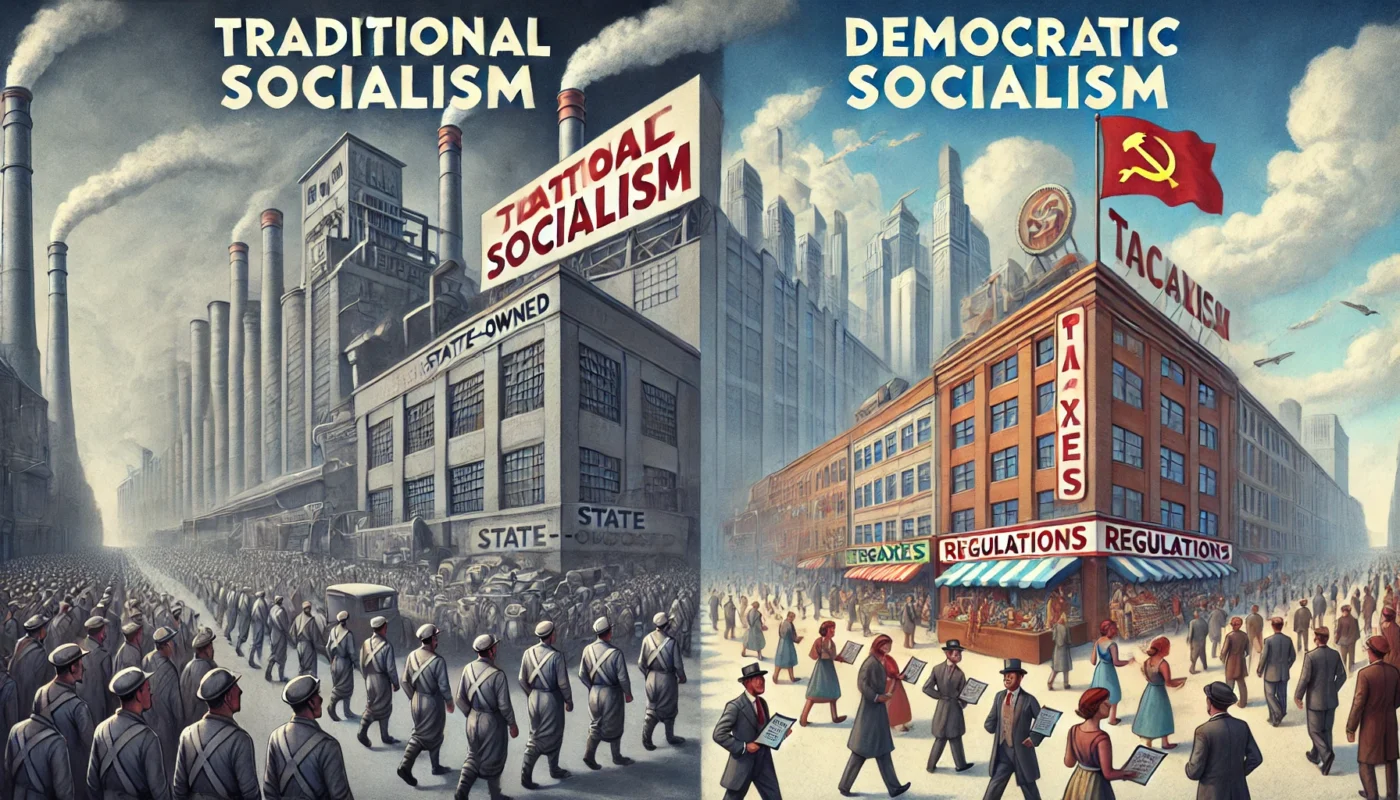
Traditional socialism is defined by state ownership of the means of production, centralized planning, and the elimination of private property. In this system:
- The government owns businesses, factories, and resources.
- Economic decisions are made by central authorities rather than markets.
- Wealth is redistributed in an attempt to achieve equality.
Democratic Socialism
Democratic socialism, as explained by Bernie Sanders, claims to reject state ownership of industries. Instead, it advocates for:
- Regulation of private businesses to align them with public interests.
- Redistribution of wealth through high taxes on individuals and corporations.
- Expansive government-run programs, including healthcare, education, and childcare.
While Sanders has stated that he does not support government ownership of the means of production, his vision involves extensive government control over economic activities through regulation, taxation, and redistribution. This raises the question: does the difference between these ideologies lie in substance or semantics?
Key Similarities
Control vs. Ownership
- Traditional socialism explicitly takes ownership of industries, removing private-sector involvement altogether. Democratic socialism avoids outright ownership but seeks to control businesses through regulations and mandates.
- Example: Sanders’s proposals include government-mandated wages, benefits, and environmental practices. These measures effectively allow the government to dictate how businesses operate, creating a de facto command economy.
Economic Impact
- Both ideologies suppress incentives for innovation and entrepreneurship.
- Historical Evidence: The collapse of the Soviet Union illustrates how removing market incentives leads to economic stagnation and inefficiency. Democratic socialism risks similar outcomes by burdening businesses with heavy regulations and taxes.
Redistribution of Wealth
- Redistribution is a cornerstone of both systems. While traditional socialism redistributes wealth through state ownership, democratic socialism achieves this through taxation and government benefits.
- Example: Sanders’s plans, such as Medicare for All and free college tuition, would require trillions of dollars in taxes, impacting not only the wealthy but also the middle class.
Key Differences
Democratic Process
- Traditional socialism often arises through revolution or authoritarian rule, while democratic socialism claims to function within a democratic framework.
- Rhetorical Strategy: Sanders frames his ideology as a grassroots effort to empower the people through elections. However, critics argue that once implemented, democratic socialism’s reliance on bureaucratic control erodes individual freedoms.
Ownership vs. Regulation
- Traditional socialism removes private ownership, while democratic socialism allows businesses to exist under strict government oversight.
- Analogical Evidence: Democratic socialism is akin to a landlord owning a building (traditional socialism) versus a landlord dictating every aspect of how tenants live in the building (democratic socialism).
The Economic Reality
Disincentivizing Growth
Both traditional and democratic socialism undermine the incentives that drive economic growth:
- High taxes on wealth and income discourage investment.
- Overregulation creates barriers for entrepreneurs and small businesses.
- Redistribution prioritizes equality over productivity, leading to stagnation.
Government as Super-CEO
Under democratic socialism, the government assumes a role akin to a super-CEO, directing economic activity from the top down. However:
- Unlike private-sector CEOs, government bureaucrats lack vested interest in profitability or efficiency.
- This approach removes market signals, leading to misallocation of resources.
Economic Outcomes
- Traditional Socialism: Historical examples, such as the Soviet Union and Maoist China, demonstrate how centralized control leads to economic collapse.
- Democratic Socialism: Scandinavian countries often cited as successful examples rely on market-driven economies with high taxes—not the level of control Sanders proposes.
Lessons from the Obama Administration
Under President Obama, the U.S. moved closer to a democratic socialist model through increased taxation and regulation. The results were mixed:
- Economic Growth: GDP growth averaged 1.6% annually, a historically low figure during a recovery period.
- Middle-Class Struggles: Wage stagnation and limited job creation undercut middle-class prosperity.
- Increased Inequality: Ironically, income inequality worsened during Obama’s presidency despite his Progressive policies.
Sanders’s democratic socialism would amplify these policies, imposing higher taxes and more regulations, further discouraging growth and innovation.
The Case for Free-Market Capitalism
Free-market capitalism remains the most effective system for generating economic growth and reducing poverty:
- Incentives Matter: Capitalism rewards innovation, hard work, and risk-taking, driving economic progress.
- Opportunity Over Redistribution: By creating opportunities for individuals to improve their circumstances, capitalism organically reduces inequality.
- Historical Evidence: Post-World War II America, fueled by market-driven growth, saw the rise of the middle class and widespread prosperity.
A Path Forward
- Regulatory Reform: Simplify regulations to encourage entrepreneurship and innovation.
- Tax Incentives: Reduce tax burdens to stimulate investment and job creation.
- Education and Training: Expand access to skills training and higher education to bridge income gaps.
Conclusion: A Distinction with Little Difference
While democratic socialism claims to differ from traditional socialism by rejecting outright government ownership, its reliance on extensive regulation, taxation, and redistribution leads to similar outcomes. Both ideologies stifle economic growth, suppress innovation, and prioritize equality of outcomes over opportunity.
Democratic socialism may be dressed in the language of democracy and fairness, but beneath the surface, it remains socialism—a system historically associated with stagnation and decline. The solution lies not in rebranding socialism but in embracing the proven principles of free-market capitalism to foster growth, opportunity, and prosperity for all.
SOURCES
- Difference Between Socialism and Democratic Socialism: This article outlines the key differences between socialism and democratic socialism, focusing on aspects like economic systems, governance, and individual rights.
- Bernie Sanders’s Definition of Democratic Socialism, Explained: An analysis of Bernie Sanders’s interpretation of democratic socialism, discussing how it contrasts with traditional socialism and its implications in the American political landscape.
- Democratic Socialism vs. Socialism – What’s the Difference?: This resource compares democratic socialism and socialism, highlighting their approaches to economic systems, government roles, and political structures.
- Here’s How Bernie Sanders Explained Democratic Socialism: A summary of Bernie Sanders’s speech at Georgetown University, where he defines his vision of democratic socialism and how it differs from traditional socialism.
- Socialism vs. Democratic Socialism: What’s the Difference?: An article that explores the distinctions between socialism and democratic socialism, focusing on their principles, goals, and methods of implementation.