 by
by Wealth Inequality: A Nuanced Perspective
Wealth inequality has undeniably increased in recent years, sparking heated debates about its implications. However, it is essential to recognize that wealth is not a zero-sum game. The growth of wealth among the rich does not inherently mean that the poor are becoming poorer. In fact, recent trends reveal that even as stock and real estate values have soared—primarily benefitting asset owners—the poverty rate in the United States has declined.
The Reality of Wealth Inequality
A 2016 Congressional Budget Office (CBO) report, Trends in Family Wealth 1989 to 2013, offers critical insights. It found that the share of wealth held by families in the top 10% of the distribution rose from 67% to 76% during this period. Meanwhile, the share held by families in the bottom 50% fell from 3% to just 1%. This disparity, while significant, is not surprising given the nature of wealth accumulation. Wealthier families are more likely to own appreciating assets like stocks and real estate, which naturally increases their net worth when those markets perform well.
However, it is a fallacy to interpret these numbers as evidence that the rich are gaining wealth at the expense of the poor. Wealth creation, particularly in a free-market economy, involves generating value, not merely redistributing existing resources. Rising asset values primarily benefit those who own them but do not inherently reduce opportunities for others to build wealth.
The Role of Monetary Policy in Wealth Inequality
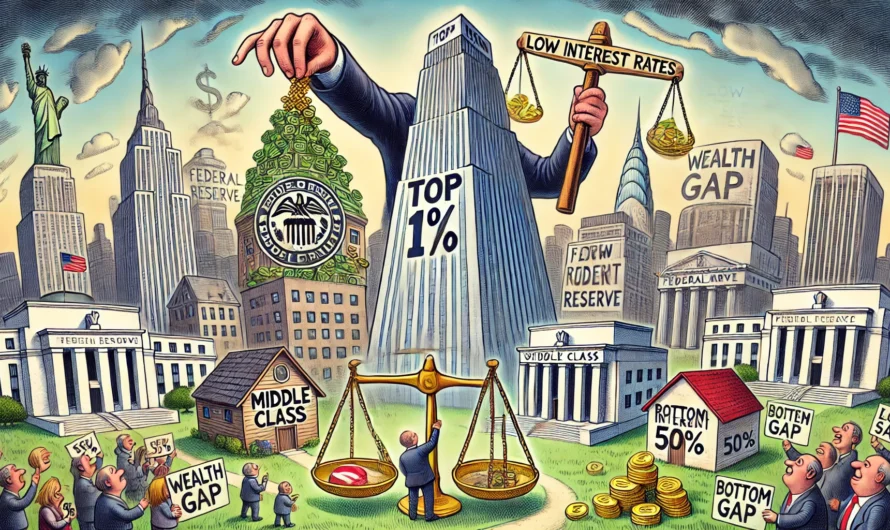
One of the most significant drivers of wealth inequality in recent decades has been the Federal Reserve’s prolonged period of low interest rates. Designed to stimulate economic growth, these low rates have disproportionately benefitted asset owners.
- Stock Market Gains: With low returns on interest-bearing investments like bonds, investors have flocked to the stock market, driving up demand and prices. Between 2009 and 2016, the S&P 500 rose 235%, fueled by monetary policy and economic recovery.
- Real Estate Boom: Similarly, low interest rates incentivized real estate purchases, increasing demand and driving up property values. In 2017 alone, the Federal Reserve reported a $1.1 trillion increase in stock values and a $600 billion rise in real estate values in the second quarter, followed by further gains in the third quarter.
While these trends have significantly increased the wealth of stock and property owners, participation in these gains requires ownership. Those without access to these assets—often lower-income families—miss out on the benefits, exacerbating wealth inequality.
Wealth Inequality and Poverty: Not Directly Correlated
Importantly, increasing wealth inequality does not equate to increasing poverty. Data shows that even as wealth inequality has grown, poverty rates have declined. For example, in 1989, when economic inequality was less pronounced, the poverty rate for families was 10.3%. By 2016, despite rising inequality, the poverty rate had fallen to 9.8%.
Conversely, during the Great Recession, the poverty rate spiked to 11.8% between 2010 and 2012, coinciding with a decline in the value of stocks and real estate. These trends suggest that economic growth benefits both the wealthy and the poor, while economic contraction harms all groups.
A Rising Tide Lifts All Boats
The relationship between wealth inequality and poverty underscores a critical point: wealth is not a fixed resource. The poor do not necessarily get poorer when the rich get richer, nor do they become wealthier when the rich lose wealth. Instead, a healthy, growing economy can increase wealth at all income levels, improving standards of living across the board.
Wealth inequality reflects disparities in asset ownership and economic participation, but it does not negate the fact that living standards have improved over time. Investments in education, access to financial markets, and policies that promote economic opportunity can help more people participate in wealth creation, ensuring that the benefits of growth are broadly shared.
Conclusion
Wealth inequality is a complex issue that requires careful analysis and nuanced understanding. While it is true that the share of wealth held by the top 10% has grown, this does not imply that the poor are worse off. Economic growth, driven by rising asset values, has lifted living standards and reduced poverty over time. The challenge lies in creating pathways for more Americans to access wealth-building opportunities, ensuring that the tide lifting all boats continues to rise.
10 Action Steps to Address Wealth Inequality
1. Promote Tax Simplification
Action: Replace complex, loophole-ridden tax codes with a flat or simplified tax system.
Explanation: A simplified tax system reduces favoritism toward special interests, ensures fairness, and minimizes government intrusion into individual financial decisions. This empowers working-class citizens by making the system transparent and predictable, avoiding hidden tax burdens.
2. Reduce Corporate Welfare
Action: End subsidies, bailouts, and tax breaks for large corporations.
Explanation: Corporate welfare distorts the free market and disproportionately benefits wealthy elites while burdening taxpayers. A populist approach ensures small businesses and individuals are not disadvantaged by crony capitalism.
3. Encourage Widespread Asset Ownership
Action: Expand access to investment vehicles like 401(k)s and IRAs, and provide incentives for employee stock ownership plans (ESOPs).
Explanation: Encouraging middle- and working-class Americans to own stocks and other appreciating assets closes the wealth gap by enabling participation in market gains without direct government redistribution.
4. Eliminate Barriers to Entrepreneurship
Action: Roll back excessive regulations that stifle small businesses and startups.
Explanation: Many regulations disproportionately harm smaller businesses, preventing them from competing with large corporations. Limited-government advocates argue that reducing these barriers promotes innovation and creates economic mobility.
5. Promote Financial Education
Action: Implement community-driven financial literacy programs to teach citizens how to save, invest, and build wealth.
Explanation: Empowering individuals with knowledge about personal finance fosters self-reliance and reduces dependence on government programs. Financial education equips citizens to make informed decisions about wealth-building opportunities.
6. Rein in Central Bank Policies
Action: Limit the Federal Reserve’s ability to artificially lower interest rates over prolonged periods.
Explanation: Loose monetary policies disproportionately benefit the wealthy, who own appreciating assets like stocks and real estate. A populist approach advocates for policies that prevent inflationary bubbles and ensure fair access to capital.
7. Focus Welfare Programs on Workforce Integration
Action: Reform welfare programs to emphasize job training and work requirements rather than long-term dependency.
Explanation: Welfare should serve as a safety net, not a lifestyle. Limited-government advocates believe in policies that provide temporary support while equipping individuals to re-enter the workforce, fostering dignity and independence.
8. Decentralize Education and Job Training
Action: Shift control of education and vocational programs to state and local governments, and partner with private industries for training.
Explanation: A decentralized approach ensures programs are tailored to local needs and reduces federal bureaucracy. Populists support empowering communities to train workers for high-demand, well-paying jobs.
9. Protect Small Property Owners
Action: Reduce property taxes and offer protections against eminent domain abuse.
Explanation: High property taxes disproportionately hurt working-class families and retirees. Limiting eminent domain abuse prevents wealthy developers and government agencies from displacing ordinary citizens.
10. Champion Trade Policies That Prioritize American Workers
Action: Implement trade agreements that discourage outsourcing and protect U.S. industries from unfair foreign competition.
Explanation: Populists argue that trade policies should prioritize the economic well-being of American workers, ensuring that wealth creation benefits domestic communities rather than enriching multinational elites at their expense.
SOURCES
- Trends in U.S. Income and Wealth Inequality
This Pew Research Center report examines the rise in economic inequality in the U.S., exploring factors such as technological change, globalization, and the decline of unions. - How the Federal Reserve Is Increasing Wealth Inequality
An analysis by ProPublica discussing the unintended consequences of the Federal Reserve’s policies on economic inequality, particularly through stock market booms. - Nine Charts about Wealth Inequality in America
The Urban Institute presents visual data illustrating wealth disparities over time across race and age, highlighting contributing factors to wealth inequities. - Wealth Inequality and the Racial Wealth Gap
A Federal Reserve analysis exploring the distribution of wealth among different racial groups and the persistent racial wealth gap in the U.S. - The State of U.S. Wealth Inequality
A report by the Federal Reserve Bank of St. Louis providing insights into wealth trends among various demographic groups since the Great Recession. - Wealth Inequality in the United States since 1913: Evidence from Capitalized Income Tax Data
An academic study published in the Quarterly Journal of Economics analyzing wealth concentration trends in the U.S. over the past century. - Is the Federal Reserve Contributing to Economic Inequality?
A discussion by the Federal Reserve Bank of San Francisco on the impact of monetary policy on economic inequality and potential measures to address it. - Wealth Inequality in the United States
An overview by the National Bureau of Economic Research summarizing studies on wealth trends and inequality over the past 60 years. - Wealth Inequality in America over Time: Key Statistics
A blog post by the Federal Reserve Bank of St. Louis presenting key statistics on the state of wealth and income inequality in the U.S. using recent data. - Wealth Inequality in the United States
An analysis by the Institute for Policy Studies discussing the disparities of wealth between rich and poor in the U.S. compared to other developed nations.


