by
by The Resurgence of Academic Progressivism
When the Soviet Union fell in 1991, it seemed as though the century-long ideological battle against communism had ended decisively. The triumph of capitalism over socialism was clear, marked by the fall of the Berlin Wall and Eastern Europe’s embrace of free markets. Former Soviet Premier Nikita Khrushchev’s prediction that “we will bury you” was turned on its head as socialist central planning crumbled in the face of capitalist free markets. At the time, jokes circulated that the only place where central planning was still believed in was Harvard’s political science department.
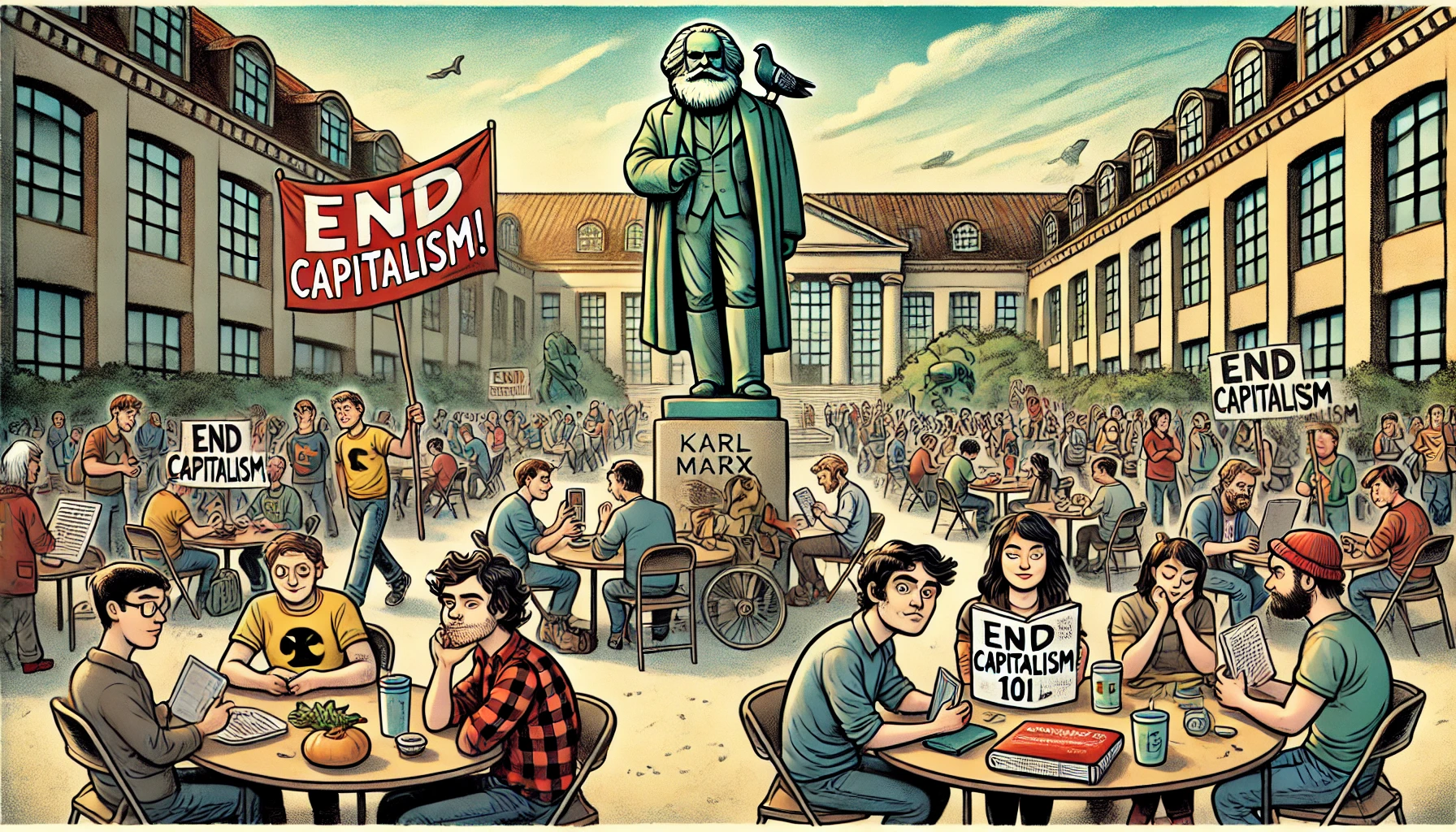
For a while, even in academia, communism and central planning were in disrepute. Professors distanced themselves from Marxist ideologies. Yet, the ideological retreat was temporary. Today, progressive ideologies have returned with a vengeance in academia, where left-wing perspectives dominate, shaping generations of students and influencing societal discourse.
The Decline of Marxism in Academia Post-Cold War
The collapse of the Soviet Union and the failures of socialism prompted an intellectual reckoning in academia. During the late 1980s and early 1990s, it became unfashionable to identify as a Marxist, even among left-leaning professors. A University of Michigan law professor noted in 1989 that many intellectuals were retreating from Marxism, acknowledging its declining credibility.
Similarly, a historian at MIT quipped, “A Marxist revolutionary is hard to find,” reflecting the broader disillusionment with socialism’s promises. Professors who once championed Marxist ideologies turned their focus elsewhere, distancing themselves from the stigma associated with the Soviet Union’s failures.
For a time, it appeared that academia was turning away from centralized planning and redistribution. However, this ideological retreat was short-lived, and the seeds of a resurgence were already being planted.
The Resurgence of the Academic Left
Over the past three decades, progressive ideologies have regained their foothold in academia, particularly in the humanities and social sciences. As memories of the Soviet Union’s collapse faded, left-leaning professors rationalized socialism’s failures, attributing them to poor implementation rather than fundamental flaws in the system.
Today, left-wing professors dominate American higher education. A 2016 study of faculty political affiliations at 40 top-ranked universities found an average ratio of 11.5 Democrat professors for every 1 Republican. The imbalance is even more pronounced at elite institutions like Columbia and Cornell, where the ratio climbs to 30:1. At Brown University, the ratio reaches a staggering 60:1.
This dominance is reflected in the ideological orientation of faculty. According to UCLA’s Higher Education Research Institute, the percentage of professors identifying as “liberal” or “far left” grew from 42% in 1990 to over 60% by 2014. In contrast, conservative faculty are increasingly confined to fields like engineering, where political ideologies are less central.
The Consequences of Ideological Imbalance
The dominance of the academic left has significant implications for intellectual discourse. The Heterodox Academy, an organization advocating for viewpoint diversity, warns that a lack of ideological balance stifles debate and discourages dissent. When nearly all faculty in a discipline share the same political orientation, certain ideas become orthodoxy, shielding them from critical scrutiny.
This homogeneity is particularly evident in the humanities and social sciences. Conservative perspectives are virtually absent, creating a narrow intellectual landscape. Graduates from these programs often emerge with a one-sided worldview, influencing industries such as journalism, public policy, and entertainment.
Moreover, this ideological imbalance contributes to cultural and political polarization. Universities play a central role in shaping societal narratives. When students are exposed to predominantly progressive perspectives, the ripple effects extend far beyond the classroom.
Prominent Figures of the Academic Left
Prominent academics have been at the forefront of the progressive resurgence in higher education. Sociologist Erik Olin Wright, a professor at the University of Wisconsin–Madison, exemplifies this trend. A self-described Marxist and activist, Wright has authored works like How to Be an Anti-capitalist for the 21st Century. He advocates for “anti-capitalist forces to amass enough power to destroy capitalism,” suggesting strategies such as “smashing,” “taming,” or “eroding” the system.
Wright’s radical views have not hindered his career. In 2012, he was elected president of the American Sociology Association, cementing his influence in academic sociology. Despite his controversial positions, Wright’s work is widely taught in sociology programs across the United States.
Similarly, anthropologist David Graeber gained fame as a founder of the Occupy Wall Street movement. Graeber, an anarchist and critic of capitalism, popularized the slogan “We are the 99 percent.” His work exemplifies the intersection of academic theory and progressive activism.
Even economics, a discipline traditionally grounded in free-market principles, has seen a shift toward progressive ideologies. Paul Krugman, a Nobel Prize-winning economist and New York Times columnist, has become a prominent advocate for redistribution, government regulation, and progressive economic policies. While Krugman once supported free trade and market-driven solutions, his recent writings champion left-leaning economic reforms.
The Influence of Progressive Academia
The resurgence of progressive ideologies in academia extends beyond the faculty lounge. Universities shape the ideas and values of future leaders, making their ideological orientation deeply consequential.
Students exposed to predominantly progressive narratives often adopt these perspectives, carrying them into influential fields like media, politics, and law. This creates a feedback loop that amplifies the reach of progressive ideas, further entrenching their dominance in society.
The cultural influence of academia is evident in movements like Occupy Wall Street and the rise of Democratic Socialism among young Americans. These trends reflect the success of academic institutions in framing progressive ideologies as morally and intellectually superior.
Resistance to Intellectual Diversity
Efforts to address the ideological imbalance in academia have faced significant resistance. Organizations like the Heterodox Academy advocate for viewpoint diversity, emphasizing the importance of open debate. However, these initiatives often encounter pushback from faculty who view conservative ideas as antithetical to their mission.
This resistance perpetuates the echo chamber effect, where dissenting perspectives are marginalized or dismissed. The absence of intellectual diversity undermines universities’ ability to serve as spaces for critical inquiry and free thought.
The Path Forward
To restore balance in higher education, universities must prioritize intellectual diversity. This requires a commitment to hiring practices that value diverse perspectives and curricula that expose students to a range of ideas.
Critical thinking should be central to academic programs, empowering students to evaluate complex issues independently. By fostering environments that encourage debate and dissent, universities can better prepare students for a polarized and rapidly changing world.
Conclusion
The return of the academic left reflects the enduring appeal of progressive ideologies in higher education. Despite the discrediting of socialism following the Cold War, left-wing perspectives have resurged, dominating intellectual discourse and shaping the values of future generations.
To ensure that academia remains a space for free inquiry, universities must embrace intellectual diversity and resist the temptation to enforce ideological conformity. Only then can higher education fulfill its mission as a foundation for critical thinking and democratic engagement.