by
by A Progressive Education’s Impact on Beliefs
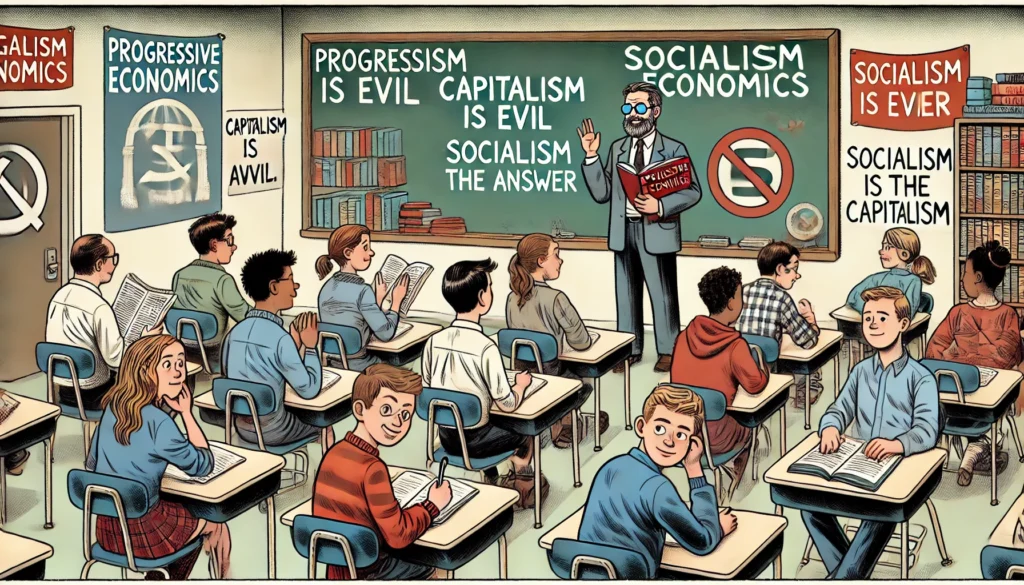
The rise of socialism among young Americans is more than a political trend—it is a direct result of a Progressive education system that has effectively indoctrinated students to view capitalism with skepticism and socialism as a more appealing alternative. From misleading textbooks to biased curricula, the education system has contributed to a generation’s lack of understanding of both the real-world implications of socialist policies and the benefits of capitalism. This essay explores the growing support for socialism among young people, the lack of economic literacy, and the role that Progressive education plays in shaping these beliefs.
Growing Support for Socialism Among Young People
A 2016 YouGov poll revealed a striking trend: 43 percent of Americans aged 18 to 29 viewed socialism favorably, compared to just 26 percent who held an unfavorable opinion. This demographic was the only age group in the poll to express more positive than negative views of socialism. This support for socialism isn’t limited to fringe elements but extends across much of the millennial and Generation Z populations, particularly among those who identify as Democrats or who supported Hillary Clinton in the 2016 election.
For many of these young Americans, socialism represents an alternative to the economic systems they perceive as flawed. Yet, much of this support appears superficial, as many young people remain largely ignorant of the historical failures of socialism, particularly in the 20th century. The systemic issues inherent in centrally planned economies, such as inefficiency, corruption, and human rights abuses, are often glossed over in their education, leading to a simplistic and flawed view of socialism as a utopian solution.
Ignorance of Communism’s Record and Capitalism’s Success
One of the most alarming aspects of the support for socialism among young people is their lack of understanding of the devastating historical consequences of communist regimes. A 2016 poll commissioned by the Victims of Communism Memorial Foundation revealed that one-third of millennials believed that George W. Bush had killed more people than Joseph Stalin. This is a stark illustration of the disconnection between modern American youth and the horrors of communist regimes. Stalin’s reign in the Soviet Union resulted in the deaths of as many as 60 million people, while Mao Zedong’s policies in China led to the deaths of an estimated 65 million. Yet, millennials are largely unaware of these atrocities, or they underestimate their scale, thanks to a skewed educational narrative.
Meanwhile, many of the same young people remain woefully uninformed about the successes of capitalism, which has lifted billions of people out of poverty, spurred technological innovation, and created opportunities for millions across the globe. The fall of the Soviet Union and the transition of China towards market-oriented reforms in the late 20th century demonstrated that free-market systems work far better than socialist or communist alternatives. Yet these lessons are often omitted, downplayed, or distorted in the curricula that students are taught.
The Lack of Economic Literacy
The gap in understanding capitalism and socialism is not merely an academic issue; it has real-world implications. Nationwide testing in 2012 showed that fewer than half of America’s 12th graders were proficient in basic economics. This is a serious problem, especially considering that an understanding of economics is vital for navigating today’s complex global economy. Furthermore, the problem is exacerbated in minority communities, with only 17 percent of African American students and 26 percent of Hispanic students demonstrating proficiency in economics.
This lack of economic knowledge does not end with basic economics. In a 2016 survey by the Financial Industry Regulatory Authority (FINRA), two-thirds of Americans failed a test on financial literacy. This is an alarming statistic, particularly when one considers the long-term consequences of financial illiteracy. Young people who cannot grasp basic financial concepts such as budgeting, saving, and investing are ill-equipped to succeed in an economy where financial decisions are a constant part of daily life.
In addition, surveys conducted by Gallup on financial illiteracy revealed similar results: Americans struggled with basic questions about risk diversification, inflation, and compound interest. These concepts are critical for understanding how the economy works and how individuals can manage their personal finances, yet they are largely ignored or underemphasized in the current curriculum.
The Appeal of Socialism’s Simplicity
Why, then, do so many young people gravitate towards socialism? Is it simply because they fail to understand the complexities of capitalism? The answer is both yes and no. It is true that capitalism’s dynamic ability to create opportunity and prosperity can be difficult to grasp, especially when students are not given the tools to fully understand economic systems. But there is also a simpler, more troubling reason for the preference for socialism: it offers an easy and emotionally satisfying solution to the world’s problems.
Socialism promises “equality of poverty”—a simplistic solution that appeals to young people who are frustrated with the perceived inequities of the capitalist system. The allure of equality, especially in a world where wealth inequality is a significant issue, is undeniable. However, the reality of socialism’s implementation has been disastrous: poverty, oppression, and a lack of freedom. Yet this reality is seldom discussed in the classrooms where many young people are being taught.
When students are not exposed to the shortcomings of socialist systems, they are more likely to embrace these ideals without considering their practical implications. This is where the failure of the education system becomes apparent. Young people are not hearing both sides of the argument; they are only hearing the Progressive narrative.
The Role of Teachers and Teachers’ Unions
Teachers play a crucial role in shaping the perspectives of young people, and unfortunately, many educators have become unwitting (or deliberate) conduits for Progressive ideologies. In an education system dominated by teachers’ unions and Progressive advocacy, it is not surprising that so many teachers advocate for socialist ideas in the classroom.
Teachers’ unions, particularly the National Education Association (NEA) and the American Federation of Teachers (AFT), are heavily involved in political lobbying and advocacy. The NEA alone spent over $20 million on political contributions in 2015 and 2016, with the overwhelming majority directed toward left-wing causes and Democratic candidates. The AFT has also been active in promoting Progressive policies, including pushing for higher taxes, expanding government welfare programs, and opposing market-based education reforms like school choice and charter schools.
As a result, teachers often find themselves in positions where they must adhere to a Progressive agenda, whether they agree with it or not. In some cases, teachers are openly encouraged to promote anti-capitalist viewpoints. For instance, some textbooks, like those written by Howard Zinn, portray American history through a Marxist lens, framing capitalism as a system of exploitation. Teachers who use such materials pass these ideologies on to their students, reinforcing the notion that capitalism is inherently unjust.
The Consequences for Students
The consequences of this Progressive education are profound. First and foremost, young people are left with a skewed understanding of capitalism, which undermines their ability to critically engage with economic systems. When students are taught that socialism is the answer to inequality without being given a proper understanding of capitalism’s successes, they are ill-prepared to make informed decisions about public policy or their own financial futures.
Moreover, the lack of financial literacy is a serious problem. As more young people enter adulthood without basic knowledge of economics or personal finance, they are ill-equipped to manage their money, make wise financial decisions, or understand how economic policies will impact their lives. This lack of financial literacy contributes to a cycle of ignorance and poor decision-making that can have long-lasting consequences for individuals and society as a whole.
Finally, the promotion of socialist ideologies without a balanced understanding of history and economics contributes to a generation that is prone to ideological extremes. The idealism of youth, combined with a lack of exposure to the failures of socialism, can lead to unrealistic expectations and misplaced anger toward capitalist systems. This can contribute to political polarization and hinder productive debate about the future of America’s economy and government.
Proposed Solutions
To address the imbalance in education, several reforms should be considered:
Mandating a Seminar on Capitalism
State legislatures should require high school students to take a comprehensive seminar on capitalism as part of their graduation requirements. This seminar should include lessons on the history of economic systems, the benefits of capitalism, and the practical applications of free-market principles. It should also explore the historical failures of socialism, with a focus on the human cost of communism.
Balanced Educational Materials
Textbooks and teaching materials must present a more balanced view of American history and economics. Curriculum developers should work to ensure that students are exposed to a variety of perspectives, including the successes of capitalism and the problems associated with socialist policies. This approach would help foster critical thinking and give students the tools they need to engage with the real world.
Promoting Financial Literacy
In addition to teaching economic theory, schools should incorporate financial literacy into their curricula. Students should graduate with a basic understanding of personal finance, including budgeting, saving, and investing. These skills are crucial for success in adulthood and will help prepare students to navigate the financial challenges they will inevitably face.
Conclusion
The growing support for socialism among young Americans is a direct result of a Progressive education system that has failed to provide a balanced understanding of capitalism and economics. By focusing on the promotion of socialist ideologies and downplaying the benefits of free-market systems, our education system has contributed to a generation that is ill-prepared to make informed decisions about their future.
To address this issue, we must prioritize educational reforms that promote intellectual diversity, critical thinking, and economic literacy. By mandating capitalism seminars, promoting balanced textbooks, and incorporating financial literacy into the curriculum, we can ensure that future generations are better equipped to navigate the complexities of the modern world.
It is time to ensure that students hear both sides of the debate and are given the opportunity to think critically about the world they will inherit. Only then can we truly empower them to shape a better future.
A Progressive Education’s Impact on Beliefs
Introduction
- Thesis: Progressive education has led to the promotion of socialist ideologies among young people, leading to widespread support for socialism, while fostering ignorance about capitalism and economic literacy.
- Overview: The essay will explore the growing support for socialism among young people, their lack of understanding about capitalism’s positive impact, the role of Progressive education in shaping these beliefs, and propose solutions for reform.
I. The Growing Support for Socialism Among Young People
- A. Polling Data (2016 YouGov Poll)
- 43% of Americans ages 18-29 have a favorable view of socialism, compared to just 26% who view it unfavorably.
- The only age group to have more positive than negative views on socialism, highlighting the growing trend.
- B. Socialism’s Popularity Among Millennials
- Majority of millennial Democrats and Clinton voters express preference for socialism over capitalism.
- One-third of millennials overall, regardless of political party, support socialism as an economic system.
- C. Lack of Understanding of Socialism’s Real Costs
- Millennials lack knowledge of the disastrous consequences of socialism in the 20th century (e.g., Soviet Union, Cuba, Venezuela).
- A failure to recognize the historical suffering caused by communist regimes, including mass deaths under leaders like Stalin and Mao.
II. Ignorance of Capitalism’s Successes
- A. A Lack of Awareness About Capitalism’s Positive Impact
- The fall of the Soviet Union and China’s shift to market reforms showcased capitalism’s ability to reduce poverty, foster innovation, and increase prosperity.
- Despite this, many young people are unfamiliar with the practical benefits of capitalism.
- B. The Consequences of Underestimating the Dangers of Communism
- 1. Poll Data from Victims of Communism Memorial Foundation
- One-third of millennials believed George W. Bush killed more people than Joseph Stalin.
- 75% of millennials underestimated the number of people killed by communist regimes.
- 2. Failure to Understand the Historical Record
- Stalin’s regime in the Soviet Union killed an estimated 60 million people.
- Mao’s policies in China resulted in the deaths of 65 million people.
- 3. Lack of Knowledge of Global Capitalism’s Success
- Capitalism has driven unprecedented growth, lifted millions out of poverty, and promoted global prosperity.
- Young people are not exposed to these facts in their education.
- 1. Poll Data from Victims of Communism Memorial Foundation
III. The Impact of Progressive Education
- A. The Role of Progressive Ideology in Education
- The educational system, particularly through Progressive teachers’ unions, promotes socialism and undermines the teaching of capitalism.
- 1. Teachers’ Unions and Their Political Influence
- The NEA and AFT invest millions in supporting Progressive causes and politicians, which influences curriculum choices.
- The unions work to prevent the adoption of market-based reforms like school choice or charter schools.
- B. Progressive Curriculum in Schools
- Many textbooks, including A People’s History of the United States by Howard Zinn, promote a Marxist interpretation of American history, portraying capitalism as a system of oppression.
- 1. Zinn’s Influence in the Classroom
- Zinn’s book is widely used in high schools and remains one of the most popular texts on American history.
- The Zinn Education Project provides teaching resources that align with his anti-capitalist, anti-American views.
- 2. The Shift Towards Activist Education
- Schools increasingly focus on promoting social justice ideologies rather than teaching balanced, factual history or economics.
- Social justice groups and teachers’ unions create and distribute materials that emphasize radical reform over intellectual exploration.
IV. The Consequences for Young People
- A. The Rise of Ideological Extremism
- Students are exposed to a one-sided perspective on history and economics, leaving them vulnerable to ideological extremism.
- The lack of diverse viewpoints fosters an environment where students embrace radical ideologies without understanding their real-world implications.
- B. Intellectual and Economic Ignorance
- 1. Low Proficiency in Economics
- A 2012 national survey found that fewer than half of American 12th graders were proficient in basic economics.
- This lack of understanding is especially concerning among minority groups, with only 17% of African American students and 26% of Hispanic students demonstrating proficiency.
- 2. Financial Illiteracy
- A 2016 FINRA survey revealed that two-thirds of Americans failed basic financial literacy tests.
- The lack of financial literacy hampers students’ ability to make informed financial decisions and understand the broader economic context.
- 1. Low Proficiency in Economics
- C. The Consequences of Limited Exposure to Capitalism
- The failure to provide a well-rounded education that includes a fair examination of capitalism’s benefits contributes to a generation’s naive preference for socialism.
- 1. Preference for Socialism’s “Simplicity”
- Socialism’s promise of equality, though unattainable, offers an appealing but misguided solution to complex social and economic issues.
- 2. The Failure to Understand the Cost of Socialism
- Students are often unaware of the inefficiency, poverty, and oppression associated with socialist economies.
V. The Need for Reform
- A. Implementing a Capitalism Seminar
- 1. Proposal for State-Mandated Classes on Capitalism
- Schools should require students to take a course on the principles of capitalism, its successes, and its role in reducing poverty worldwide.
- The course should also cover the failures of socialist policies and provide real-world examples of capitalist success stories.
- 2. The Value of a Balanced Curriculum
- Education should present a balanced view of both capitalism and socialism, encouraging students to critically engage with both systems.
- Schools should focus on teaching economics and personal finance to better prepare students for the complexities of the modern world.
- 1. Proposal for State-Mandated Classes on Capitalism
- B. Promoting Financial Literacy
- 1. Financial Literacy as a Key Component of Education
- Schools should prioritize teaching students how to manage personal finances, understand economic systems, and make informed decisions about investments and savings.
- 2. Expanding Financial Education
- A financial literacy curriculum can help students better understand concepts like risk diversification, inflation, and compound interest.
- 1. Financial Literacy as a Key Component of Education
- C. Parental and Legislative Oversight
- 1. Parent Advocacy in Education
- Parents should be empowered to influence the curriculum and challenge the promotion of political ideologies in the classroom.
- 2. Legislative Action to Ensure Balanced Education
- State legislators should ensure that educational standards promote intellectual diversity and prevent one-sided indoctrination.
- 1. Parent Advocacy in Education
VI. Conclusion
- A. Reaffirmation of the Thesis
- Progressive education has contributed to a generation’s misguided support for socialism and a lack of understanding of capitalism’s role in fostering prosperity.
- B. Call for Reform
- The education system must prioritize teaching the principles of capitalism, financial literacy, and critical thinking in order to better equip students for their future.
- C. The Future of Education
- By implementing reforms that promote intellectual diversity, expose students to diverse viewpoints, and equip them with the tools to critically evaluate economic systems, we can help ensure that the next generation is prepared to engage with the world in an informed and responsible way.