by
by Political Parties and Populism: A Complex Interplay
Introduction
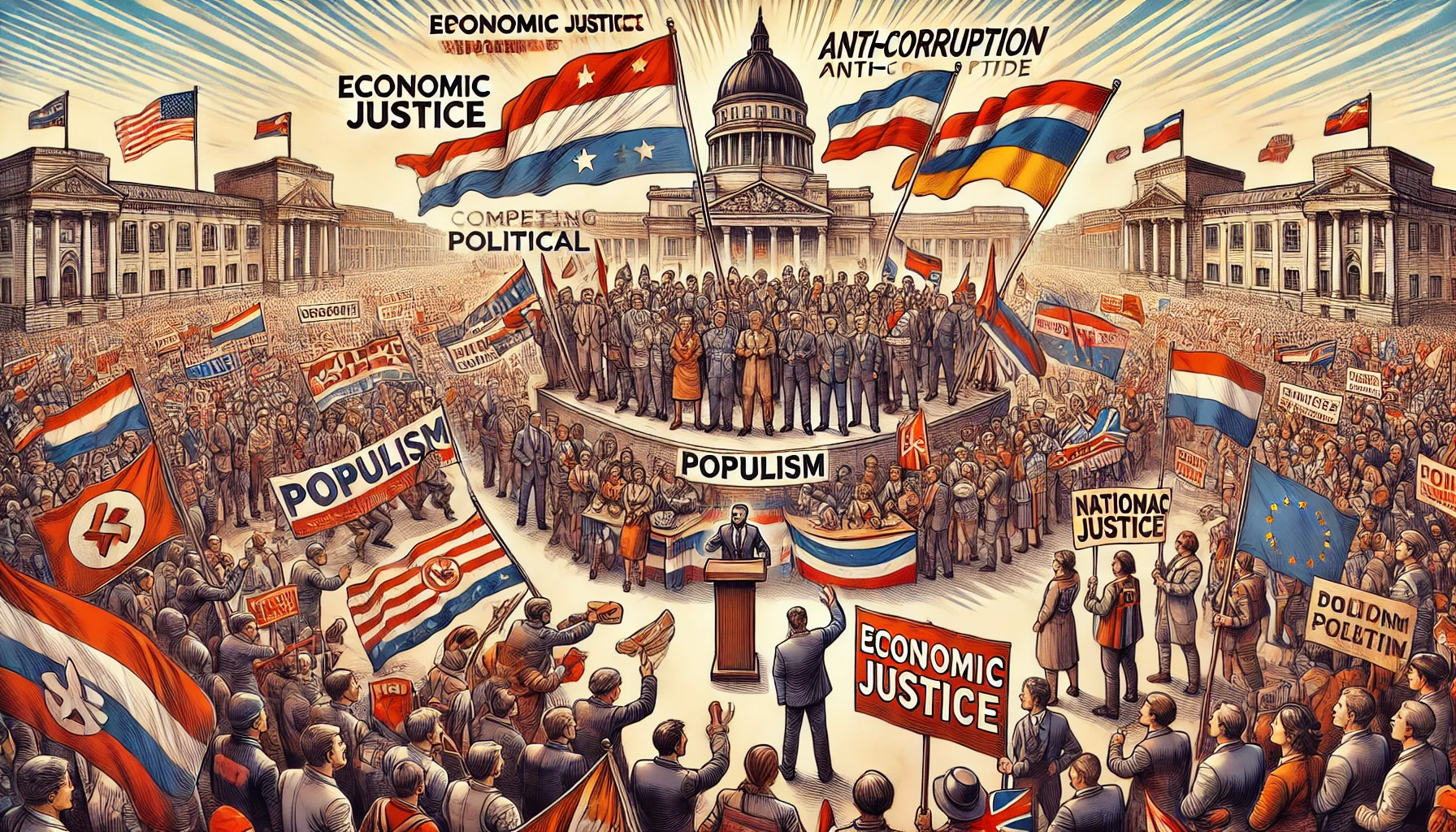
Populism and political parties are two fundamental forces shaping democratic politics, yet they have often been studied as separate phenomena. The academic fields dedicated to each have developed distinctive theories, rival paradigms, and canonical literatures. However, the rise of “populist parties” across the globe has highlighted the need for a more integrated understanding of how these forces interact. Populism, while often defined by its anti-elite and anti-establishment rhetoric, cannot be disentangled from party politics because populist leaders and movements inevitably create or co-opt political parties to serve as vehicles for electoral and policy ambitions. This essay examines the paradoxical relationship between populism and political parties, arguing that populism both challenges and transforms traditional party systems while simultaneously relying on these systems for its success.
The analysis begins by addressing the historical separation of populism and party politics as academic fields and the increasing necessity of their integration. It then explores the central paradox of populism: the simultaneous rejection of and reliance on political parties. Finally, it considers how populism challenges, transforms, and coexists with traditional party systems, focusing on the framework of representational deficiencies and the strategies populists use to build or reshape political parties.
Interplay of Populism and Political Parties
Historical Separation of Academic Fields
For decades, the study of populism and the study of political parties followed divergent paths. Scholars of populism focused on the ideational and discursive dimensions of the phenomenon, defining it as a Manichaean worldview that pits “the pure people” against “the corrupt elite.” Political party research, by contrast, emphasized the institutional, organizational, and structural dimensions of parties and their role in stabilizing democracies.
Populism was often treated as an anomaly, a disruptive force arising during periods of crisis or discontent, while political parties were seen as enduring institutions that provided representation and mediated between citizens and the state. The theoretical frameworks rarely overlapped, leading to fragmented understandings of how populism operates within democratic systems.
The Rise of “Populist Parties”
The increasing prevalence of “populist parties” has underscored the inadequacy of this separation. From SYRIZA and PODEMOS in Southern Europe to Donald Trump’s co-opting of the Republican Party in the United States, populist leaders and movements are no longer confined to transient episodes or protest politics. Instead, they have become entrenched features of party systems, fundamentally reshaping them. Populist parties challenge established norms and practices while maintaining the structures of political competition.
Academic fields have begun to converge, with scholars like Cas Mudde emphasizing that populism is not merely a rhetorical style but a thin-centered ideology often institutionalized through political parties. The need for integrated analysis has become urgent, as populism increasingly operates through the mechanisms of party politics.
Central Paradox of Populism and Political Parties
Populist Leaders and Party Creation
At its core, populism claims to reject the established institutions of representative democracy, including political parties, which it portrays as corrupt and self-serving. Populist leaders often rise to power by promising to bypass these intermediaries, offering direct representation of “the people.” For example, Rafael Correa in Ecuador famously ran for office without fielding a party slate in his first election, underscoring his independence from the traditional political class.
Despite this rhetoric, populist leaders invariably rely on political parties to achieve and maintain power. Parties provide the organizational infrastructure necessary for electoral mobilization, policy implementation, and governance. Leaders like Hugo Chávez in Venezuela and Viktor Orbán in Hungary have used parties as instruments to consolidate power and sustain their populist agendas.
Highlighting Deficiencies in Traditional Party Systems
Populism thrives on the failures of mainstream political parties, particularly their inability to represent large segments of the electorate. Established parties often become disconnected from their base, focusing on elite-driven agendas or converging on centrist policies that alienate voters. This phenomenon, described by Katz and Mair (1995) as “cartelization,” creates fertile ground for populist challengers.
Populist movements exploit these deficiencies by presenting themselves as authentic alternatives to traditional parties. They claim to restore representation to previously excluded or alienated groups. For instance, the Five Star Movement in Italy emerged as a direct response to widespread dissatisfaction with Italy’s political establishment, positioning itself as a vehicle for citizen-driven politics.
Populism as a Corrective Force
While often disruptive, populism can also serve as a corrective force within democratic systems. By mobilizing disaffected voters and articulating neglected grievances, populist parties expand the range of issues on the political agenda. They force mainstream parties to confront representational deficiencies and adapt to changing societal demands.
However, this corrective potential is limited by populism’s tendency toward personalization and centralization of power. Many populist leaders undermine democratic norms by prioritizing loyalty over institutional development, as seen in the cases of Donald Trump’s influence on the Republican Party and Jair Bolsonaro’s leadership in Brazil.
Purpose of the Analysis: Populism’s Impact on Party Systems
Framework: Representational Deficiencies
To understand populism’s relationship with political parties, it is essential to examine the representational deficiencies that enable its rise. Four key deficiencies create opportunities for populist mobilization:
- Political Exclusion: Historically marginalized groups seek representation outside traditional party structures.
- Organizational Cartelization: Established parties prioritize self-preservation over responsiveness to societal needs.
- Performance Failures: Economic crises and governance shortcomings erode public trust in mainstream parties.
- Programmatic Convergence: When major parties adopt similar platforms, voters perceive a lack of meaningful choice.
These deficiencies leave significant portions of the electorate disillusioned and receptive to populist appeals.
Populism’s Transformative Effects on Party Systems
- Challenging Established Parties: Populist parties often arise as anti-establishment alternatives, directly competing with mainstream parties. For example, Marine Le Pen’s National Rally in France has reshaped the country’s political landscape by consolidating right-wing populist sentiment and forcing traditional parties to recalibrate their platforms.
- Reconfiguring Cleavages: Populism redefines political cleavages, often emphasizing cultural and identity-based divisions. This is evident in the rise of right-wing populist parties in Europe, which frame issues like immigration and national sovereignty as central to their platforms.
- Expanding Participation: By mobilizing previously disengaged voters, populist parties increase political participation. SYRIZA in Greece successfully channeled anti-austerity protests into electoral gains, drawing support from young and disenfranchised voters.
Party-Building Strategies of Populists
Populist leaders adopt diverse strategies to institutionalize their movements. Some, like Chávez and Orbán, build strong party organizations to sustain their agendas. Others, like Bolsonaro, rely on loose coalitions and personalistic appeals, undermining party cohesion.
- Top-Down Approaches: Leaders create parties as extensions of their authority, emphasizing loyalty over ideological coherence. These parties often lack internal democracy and depend heavily on the leader’s charisma.
- Bottom-Up Movements: Grassroots populist movements like Bolivia’s MAS build parties from social and labor networks, fostering deeper connections with their constituencies.
- Hybrid Models: Some populist parties combine elements of both approaches, balancing centralized leadership with grassroots engagement.
Conclusion
The interplay between populism and political parties is defined by both tension and interdependence. Populism challenges traditional party systems by exposing their representational deficiencies and mobilizing disaffected voters. At the same time, it relies on political parties as vehicles for electoral success and governance. This paradox underscores the need for a more integrated understanding of populism and party politics.
Populism’s impact on party systems is profound, reshaping political cleavages, expanding participation, and forcing mainstream parties to adapt. However, its tendency toward personalization and institutional fragility poses significant risks to democratic norms. As populism continues to evolve, further research is needed to understand how it can coexist with and potentially strengthen representative democracy.
By addressing these questions, scholars can contribute to a more nuanced understanding of populism’s role in modern politics and its implications for the future of democratic governance.