 by
by DOGE Analysis: Bureau of Labor Statistics (BLS)
The Bureau of Labor Statistics (BLS) is a federal agency tasked with measuring labor market activity, working conditions, and price changes in the economy. While the BLS provides valuable data for policymakers, businesses, and researchers, its operations, scope, and federal management raise questions about efficiency, duplication, and alignment with a limited-government perspective.
The Bureau of Labor Statistics (BLS) measures labor market activity, working conditions, and price changes in the economy.
Does It Fit the Constitution?
The BLS operates under the Department of Labor and derives its purpose from the federal government’s broader responsibility to regulate commerce and ensure economic stability. However, collecting and publishing labor and price statistics are not explicitly enumerated in the Constitution. From a limited-government perspective, such data collection could be handled by private organizations, academic institutions, or state agencies to reduce federal involvement.
Overreach, Bloat, and Expense
Although the BLS is a vital source of economic information, its operations present challenges that hinder efficiency and highlight potential overreach:
- Redundancy with Private Sector and State Data:
- Private organizations like ADP, PayScale, and Moody’s Analytics already produce labor and economic data, often with greater timeliness and detail.
- State labor departments also collect and report employment and wage data, leading to overlaps.
- Delayed Reporting:
- Many BLS reports, such as employment and inflation data, are released with a lag, limiting their utility for real-time decision-making.
- Complex and Inaccessible Data:
- While BLS datasets are comprehensive, they are often overly complex, making them difficult for small businesses and the general public to interpret.
- High Costs:
- The BLS operates on a budget of over $600 million annually, with significant administrative and operational overhead that could be reduced through modernization or decentralization.
Could Non-Governmental Groups Do This Job?
Yes, many of the BLS’s functions could be transitioned to private organizations or state agencies:
- Private Data Providers:
- Companies like ADP, Bloomberg, and others already collect and publish labor and economic statistics, demonstrating the private sector’s capability to handle such functions.
- Universities and Research Institutions:
- Academic institutions could manage labor and price data collection through partnerships or grants, ensuring rigorous analysis without federal oversight.
- State Agencies:
- State labor departments could take on a larger role in collecting and publishing data, tailored to regional needs and priorities.
- Public-Private Partnerships (PPPs):
- Partnering with private firms and research institutions could modernize data collection and reduce administrative costs.
Streamlining Operations
If the BLS cannot be privatized or decentralized, significant reforms are necessary to make its operations more efficient and effective:
Recommended Reforms:
- Modernize Data Collection:
- Use AI and big data analytics to automate and accelerate data collection and processing, reducing delays and operational costs.
- Consolidate with State Efforts:
- Collaborate with state labor departments to reduce duplication and streamline reporting processes.
- Simplify and Improve Accessibility:
- Develop user-friendly dashboards and tools to make BLS data more accessible to small businesses, local governments, and the public.
- Focus on Key Metrics:
- Limit the BLS’s scope to critical national indicators like unemployment, inflation, and productivity, leaving granular analyses to states or private entities.
- Introduce Performance Metrics:
- Establish benchmarks for timeliness, accuracy, and accessibility to ensure accountability and continuous improvement.
Best Option: Privatize and Decentralize Data Collection
Privatizing or decentralizing the BLS’s functions would align with limited-government principles while improving efficiency. Key benefits include:
- Cost Savings: Reducing federal involvement would eliminate administrative overhead and duplication.
- Enhanced Innovation: Private organizations can leverage advanced technologies to improve data quality and timeliness.
- Localized Insights: Decentralizing data collection to states ensures more regionally relevant analyses.
Second Best Option: Reform Within Federal Control
If privatization is not politically feasible, reforming the BLS to streamline its operations is the next-best option:
- Leverage Technology: Modernize data collection methods to reduce costs and improve timeliness.
- Collaborate with States: Partner with state agencies to eliminate redundancies and improve efficiency.
- Simplify Outputs: Focus on making data more accessible and actionable for non-experts.
While this approach would improve efficiency, maintaining federal control limits the potential for market-driven innovation and responsiveness.
Worse Option: Expand the BLS’s Role
Expanding the BLS’s scope or budget would exacerbate inefficiencies and increase federal overreach. Potential issues include:
- Higher Costs: Expanding staff and programs would inflate the agency’s budget.
- Mission Creep: Taking on additional responsibilities could dilute the agency’s focus and effectiveness.
- Reduced Competition: Federal dominance in data collection could crowd out private-sector innovation.
Reasons to Restructure or Abolish BLS Functions
- Constitutional Concerns: Labor and economic data collection are not core federal responsibilities.
- Duplication: Many BLS functions overlap with private data providers and state agencies.
- Cost Inefficiency: High administrative costs could be reduced through decentralization or privatization.
- Focus on National Interests: Streamlining the BLS allows the government to prioritize essential functions while leaving detailed analyses to other entities.
Conclusion
The Bureau of Labor Statistics provides valuable economic data, but its operations are marked by inefficiencies and overlaps with private and state efforts. The Best Option is to privatize or decentralize its functions to state agencies and private organizations, leveraging innovation and market-driven solutions. The Second Best Option is to reform the BLS while maintaining federal control, while the Worse Option of expanding its role would increase costs and inefficiencies. By embracing reform or privatization, the government can ensure more efficient, timely, and relevant economic reporting.
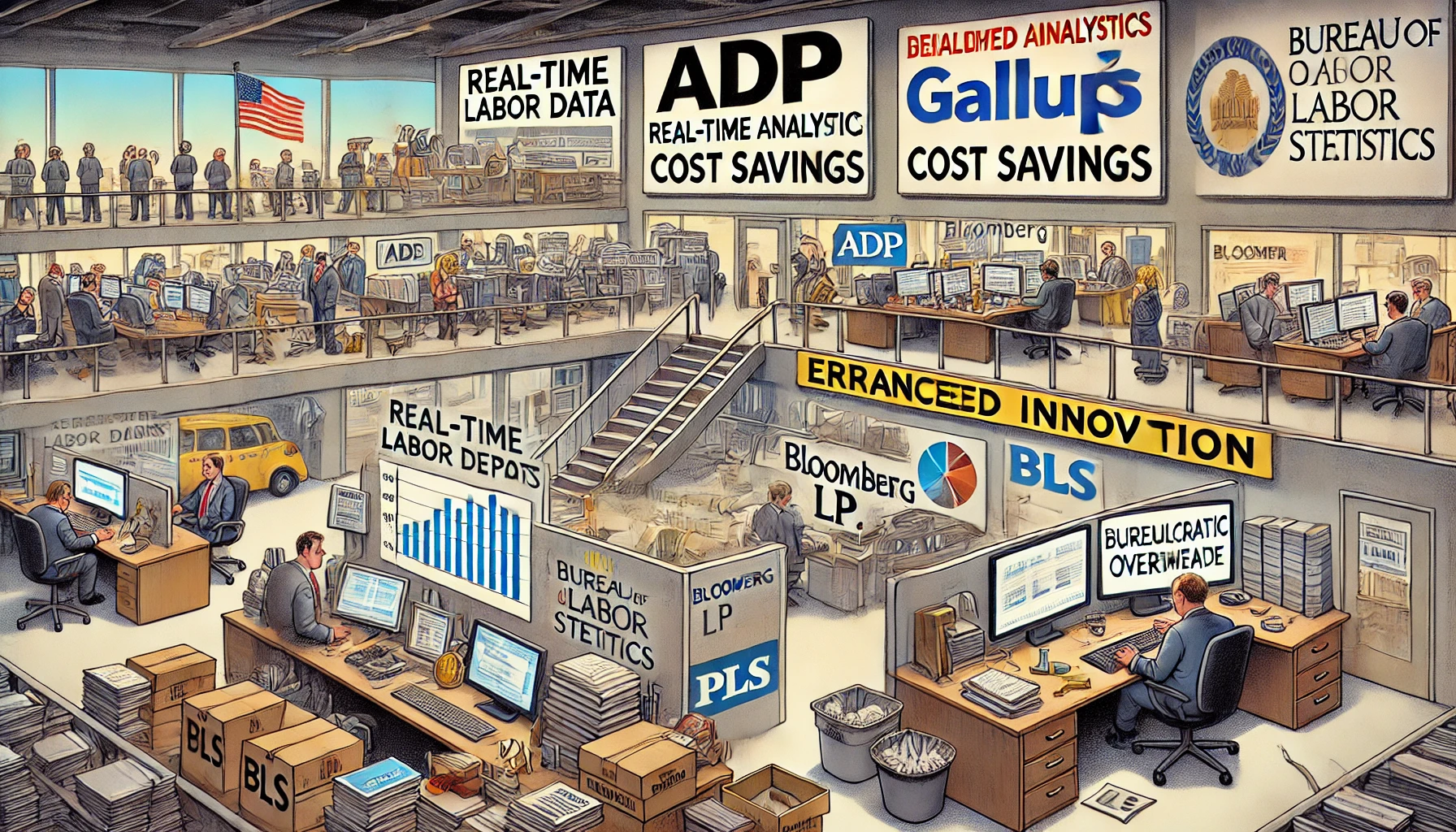
Here are five companies that could handle the privatization and decentralization of the Bureau of Labor Statistics’ (BLS) functions, leveraging their expertise in data collection, analysis, and reporting:
1. ADP (Automatic Data Processing, Inc.)
- Expertise: ADP already provides detailed payroll, employment, and wage data to businesses and governments. Its monthly ADP National Employment Report is widely regarded as a leading indicator of labor market trends.
- Capabilities: ADP’s payroll systems cover millions of workers, offering real-time insights into employment, wages, and workforce participation across industries.
2. Moody’s Analytics
- Expertise: Known for its economic research, forecasting, and analysis, Moody’s provides granular data on employment trends, productivity, and inflation.
- Capabilities: Moody’s already produces in-depth economic reports and labor market forecasts, making it a natural fit for managing and analyzing labor statistics.
3. Gallup
- Expertise: Gallup specializes in surveys and polling, including workforce-related topics such as employee engagement, job satisfaction, and well-being.
- Capabilities: Gallup’s global reach and innovative data collection methods could modernize labor statistics and provide actionable insights with a human-focused perspective.
4. Bloomberg LP
- Expertise: Bloomberg is a leader in providing economic, financial, and labor market data to businesses and policymakers.
- Capabilities: Bloomberg’s advanced technology, real-time data delivery, and global network could streamline the collection and dissemination of labor statistics.
5. Pew Research Center
- Expertise: Pew is renowned for its nonpartisan research on social trends, economics, and workforce issues.
- Capabilities: Pew’s expertise in survey methodology and data visualization would make labor statistics more accessible and user-friendly for a broad audience.
Why These Companies?
Each of these organizations already excels in collecting, analyzing, and disseminating data. Their established infrastructure and expertise make them well-suited to take over functions currently managed by the BLS, ensuring cost savings, enhanced innovation, and regionally relevant insights. Transitioning these responsibilities to such companies could reduce bureaucratic inefficiencies while maintaining or even improving the quality of labor market data.
Phone number:
1-202-691-5200
Find an office near you: