 by
by DOGE Analysis of the Center for Food Safety and Applied Nutrition (CFSAN)
Department of Government Efficiency (DOGE) Report
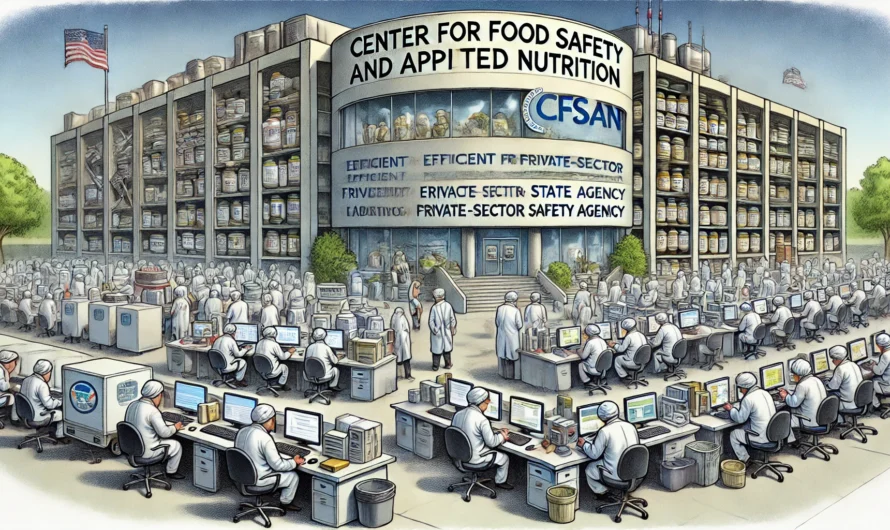
The Center for Food Safety and Applied Nutrition (CFSAN), a division of the FDA, focuses on ensuring the safety and proper labeling of food and cosmetics. It provides services to consumers and industry groups by performing scientific analyses, developing policy, and addressing critical safety and regulatory issues.
Constitutional Basis
Assessment of Legality
The federal government’s role in regulating food safety can be tied to Congress’s authority to regulate interstate commerce (Article I, Section 8). While ensuring food safety and proper labeling for interstate trade aligns with constitutional principles, limited-government critics argue that many of CFSAN’s activities, particularly those related to cosmetics and non-critical policy development, could be better handled by state governments or private-sector initiatives.
Reasons for Abolishing the CFSAN
- Overlap with Private and State Regulation:
- State agencies and private certification organizations already play a significant role in ensuring food and cosmetic safety. For example, state departments of agriculture enforce food safety regulations locally, while private groups like NSF International certify food and product safety.
- Federal oversight through CFSAN often duplicates these efforts, adding unnecessary bureaucracy.
- Inefficiency in Addressing Emerging Issues:
- Critics note that CFSAN’s slow response to emerging food safety threats (e.g., allergen labeling or contamination crises) demonstrates inefficiency compared to private testing labs or state-level intervention.
- Example: Private-sector innovation in rapid food testing has outpaced federal capabilities.
- High Administrative Costs:
- CFSAN’s budget is part of the FDA’s broader funding, exceeding $300 million annually for food safety-related activities. Limited-government advocates argue this funding could be cut significantly by outsourcing scientific analyses and inspections to private labs.
- Cosmetics Regulation as Non-Essential:
- CFSAN’s involvement in cosmetics regulation, while beneficial for consumer safety, is less critical than its food safety role. Many argue this could be privatized or regulated at the state level, reducing federal oversight in non-essential areas.
- Constitutional Concerns Over Scope:
- The broad scope of CFSAN’s activities extends beyond interstate commerce and into areas of localized or private concern, such as cosmetics formulation and small-scale food production, raising questions about overreach.
Reasons for Streamlining
- Focus on High-Priority Food Safety Issues:
- Narrow CFSAN’s focus to core responsibilities, such as addressing large-scale foodborne illness outbreaks, ensuring allergen safety, and regulating imported food products.
- Outsource Cosmetic Oversight:
- Transfer oversight of cosmetics to private certification organizations or state-level regulatory bodies, which are better positioned to manage localized and less critical concerns.
- Privatize Scientific Analysis:
- Contract with private labs to perform safety testing and contamination analysis, reducing administrative costs and improving efficiency.
- Encourage Industry Self-Regulation:
- Promote voluntary certification programs like those used in organic or allergen-free labeling, allowing industry groups to maintain high standards without direct federal intervention.
- Eliminate Non-Essential Programs:
- Identify and phase out programs that do not directly impact consumer health or safety, such as low-impact policy development and non-critical research initiatives.
Recommendations for Reform
Best Option: Abolish CFSAN and Transfer Critical Functions
Proposal: Dissolve CFSAN and transfer critical food safety oversight to private-sector labs, state governments, and other federal agencies like the USDA for agricultural products.
Rationale:
- Reduces federal redundancy and promotes efficiency through state and private-sector leadership.
- Focuses federal resources on high-impact regulatory areas, such as imports and large-scale safety concerns.
- Projected Savings: $150–200 million annually.
Second Best Option: Streamline CFSAN
Proposal: Retain CFSAN but reduce its scope by outsourcing cosmetic regulation and privatizing safety testing functions.
Rationale:
- Maintains federal oversight of critical food safety issues while reducing non-essential functions.
- Saves taxpayers money while ensuring consumer protections remain intact.
- Projected Savings: $75–100 million annually.
Worst Option: Maintain the Status Quo
Proposal: Leave CFSAN unchanged.
Rationale:
- Continues inefficiencies in addressing emerging issues and redundancy with state and private efforts.
- Missed opportunities to reduce costs and streamline operations.
- Impact: Sustained high costs and suboptimal responsiveness to consumer safety concerns.
Conclusion
The Center for Food Safety and Applied Nutrition performs important functions but operates with significant inefficiencies and overlaps with state and private efforts. Limited-government critics argue that abolishing or streamlining CFSAN would save taxpayers millions while maintaining essential safety standards through decentralized solutions. Privatization and state-level oversight offer a practical alternative that aligns with constitutional principles and promotes efficiency.
The Center for Food Safety and Applied Nutrition (CFSAN) provides services to consumers and industry groups about food and cosmetics. They perform scientific analysis, develop policy, and handle critical issues related to food and cosmetics.