 by
by DOGE Analysis of the Export-Import Bank of the United States (EXIM)
Purpose of the Agency
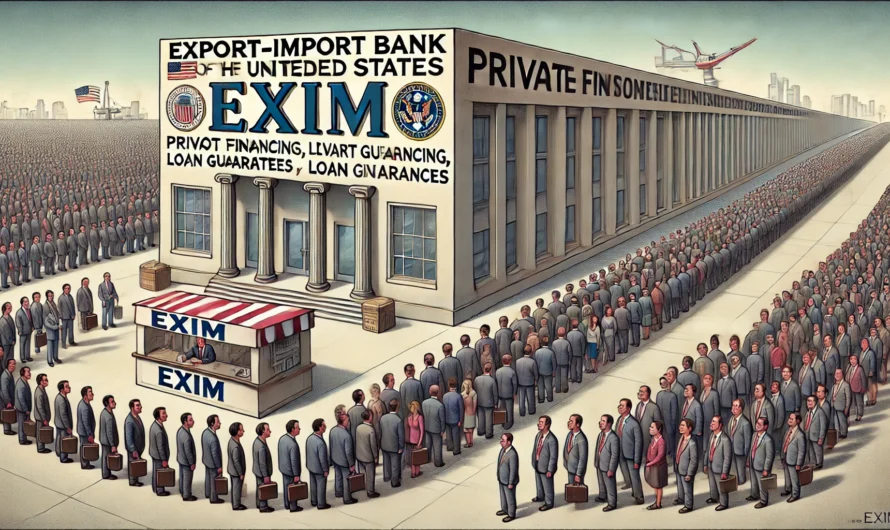
The Export-Import Bank of the United States (EXIM) facilitates American businesses’ ability to export goods by offering financial assistance, including loans, loan guarantees, and insurance. The bank’s primary focus is on assisting small businesses in expanding their reach in international markets by reducing the financial risks associated with exporting.
Constitutional Basis
Assessment of Legality
The EXIM operates under Congress’s authority to regulate commerce (Article I, Section 8) and its power to promote the general welfare. While the EXIM is constitutionally valid in terms of promoting American business interests abroad, limited-government critics argue that the U.S. government’s role in providing financial assistance to private businesses contradicts free-market principles and creates an unfair advantage for the companies it assists.
Reasons for Streamlining EXIM
- Redundancy in Government Programs:
- Several federal agencies, including the Small Business Administration (SBA) and the U.S. Trade and Development Agency (USTDA), provide similar services to support exports and assist small businesses.
- Critics argue that the EXIM duplicates efforts already being made by other government entities and that this redundancy leads to inefficiency and waste.
- Government Intervention in Markets:
- EXIM’s loan guarantees and insurance programs can distort markets by artificially propping up businesses that may not be viable without government assistance, undermining fair competition.
- Critics argue that the private sector is better suited to provide financing for exports, and the government should not be in the business of picking winners and losers.
- High Operational Costs:
- The bank’s annual budget and operations are costly, with critics questioning whether the benefits of these programs justify the expenditures, especially considering that many of EXIM’s loans are not repaid in full.
- In FY 2020, EXIM’s operating budget was $110 million. Critics argue that this funding could be used more effectively elsewhere.
- Political Influence and Risk:
- The EXIM is often criticized for favoring politically connected businesses and industries, leading to concerns about cronyism.
- Additionally, EXIM-backed loans and guarantees carry risk to taxpayers, as defaults can result in significant financial losses.
- Private-Sector Alternatives:
- Many private financial institutions are capable of offering export financing and insurance without the need for government intervention. For example, private banks and insurance companies can already provide loans, guarantees, and insurance for international trade, with fewer risks to taxpayers.
Recommendations for Reform
Best Option: Abolish EXIM and Transfer Functions to the Private Sector
Proposal: Eliminate EXIM as a standalone agency and transfer its functions to private financial institutions.
Rationale:
- The private sector can provide export financing, loan guarantees, and insurance with greater efficiency and without taxpayer risk.
- EXIM’s functions could be replaced by restructured private financial entities or through existing programs like those offered by the SBA, reducing costs and inefficiencies.
- Estimated Savings: $100–150 million annually by eliminating operational costs and removing taxpayer liability.
Second Best Option: Streamline and Focus on Small Businesses
Proposal: Retain EXIM but narrow its focus solely to assisting small businesses that lack access to private-sector financing.
Rationale:
- Rather than providing broad-based financing to all exporters, EXIM could target small businesses with limited resources that are unable to secure financing from private banks.
- Estimated Savings: $50–70 million annually by cutting back on larger loans and expanding the scope of private financial institutions.
Worst Option: Maintain the Status Quo
Proposal: Leave EXIM unchanged.
Rationale:
- Fails to address inefficiencies, redundancy, and taxpayer risk.
- Continues to create a market distortion by providing government-backed loans and guarantees to businesses, potentially hurting competition and innovation.
Efficiency Improvements (If Retained)
- Increase Private-Sector Partnerships:
- Partner with commercial banks and other private financial institutions to reduce EXIM’s operational costs while expanding its capacity to provide financing for small businesses.
- Focus on High-Risk Areas:
- Rather than covering all sectors, focus EXIM’s efforts on industries and markets where private financing is either unavailable or too risky, such as new and emerging markets.
- Reduce Overhead:
- Cut down on EXIM’s administrative expenses by eliminating redundant operations and consolidating loan processing functions.
- Introduce Performance-Based Metrics:
- Require EXIM to meet certain performance metrics, such as repayment rates or number of businesses assisted, to ensure efficiency and accountability.
- Limit Loan Guarantees to Export-Specific Products:
- Narrow EXIM’s scope to cover only specific sectors or products where U.S. businesses face the greatest export challenges, reducing the overall size of the program.
Reasons for Streamlining EXIM
- Cost Savings:
- Privatizing EXIM or reducing its scope would generate savings that could be redirected to more critical areas, including reducing the federal budget deficit.
- Reducing Market Distortion:
- By eliminating government-backed loans, EXIM would allow the private sector to play a larger role in export financing, promoting fair competition.
- Focus on Small Businesses:
- Streamlining EXIM to focus only on small businesses aligns with the core mission to assist those with limited access to capital.
Conclusion
The Export-Import Bank plays a critical role in supporting U.S. exports, but its efficiency and long-term value are increasingly questioned. Streamlining the bank’s operations or shifting its functions to private-sector institutions would reduce taxpayer risk, increase market competition, and lower operational costs. Privatization or a more focused approach would allow EXIM to maintain its support for small businesses while reducing inefficiencies and unnecessary government intervention.